%20(1)%20(1).gif)

Why AI-Native System Integration Starts With an Ontology Engine — Not a Migration Script

The Blind Spot in Enterprise AI
Walk into any enterprise today and ask:
“Where is your revenue data actually stored?”
You’ll see people look at each other.
ERPs, CRMs, finance systems, warehouses, custom apps, spreadsheets, data lakes, integrations layered over integrations… and decades of implicit logic buried in tables no one remembers owning.
Yet everyone is rushing to build AI copilots, automate workflows, migrate systems, or consolidate on Snowflake, Databricks, BigQuery, or SAP.
Here’s the punchline:
If your AI doesn’t understand your data, it can’t automate anything meaningful.
Before data migration.
Before data integration.
Before analytics.
Before data governance.
Before agentic workflows.
You need a digital twin that understands the ontology of your data.
We call it the Self-Learning Data Dictionary — the first AI agent in the Turgon stack.
A Data Dictionary - Built for 2026 Not 1996
Traditional data dictionaries were documentation.
Stale, manually written, instantly outdated.
Enterprises abandoned them because they weren’t alive.
Today’s world demands something different:
- Self-maintaining
- AI-first, not human-first
- Integrated into every downstream workflow
- Queryable, reasoning, adaptive
Not a document - A brain.
A knowledge graph that understands your enterprise data in real time.
Turgon’s Data Dictionary Agent: Ontology of your Enterprise Data
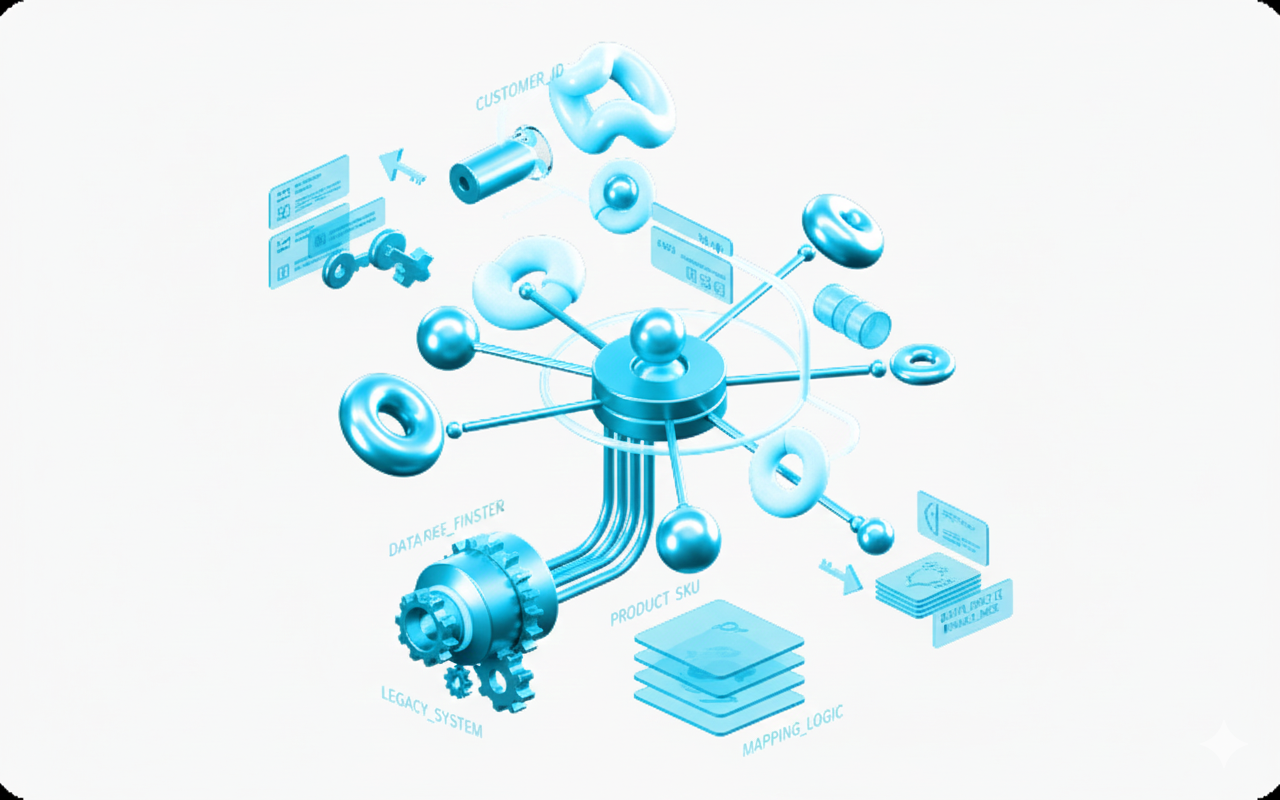
At Turgon, the first agent we deploy is a Data Dictionary / Ontology Agent that does four things:
1. It reads your systems like an AI auditor.
Across ERPs, CRMs, finance, HR, supply chain, POS, custom apps.
It automatically pulls:
- Schemas
- Column names
- Datatypes
- Comments
- FKs / PKs
- API shapes
- Table relationships
- Historical evolution
This is the “I see the structure of your world” stage.
2. It samples and profiles the data like a forensic analyst.
For every column:
- First 5 rows
- Last 5 rows
- Random 5 rows
- Min, Max
- Mean, Median, Mode
- Std Dev
- Null %
- Cardinality
- Text length distributions
- Date ranges
- Pattern detection (emails, phone numbers, URLs, product codes)
This answers: “I see what your world is filled with.”
3. It guesses what each column means — and then tests itself.
This is where the magic happens.
The agent forms a hypothesis:
“This looks like revenue.”
Then it asks itself:
“If this is revenue, what else must be true?”
And runs checks:
- No negative values
- Quarterly sums align with annual totals
- Values correlate with invoice amounts
- There exist preceding purchase orders
- Downstream there are cash entries
- Time windows match fiscal calendars
If something doesn’t line up, it discards the hypothesis and tries a new one — with the added context it just learned.
This recursive “guess → validate → refine” loop builds real semantic understanding.
This is how humans reason.
We just automated it with AI.
4. It builds a knowledge graph of your entire enterprise.
When the loop converges, the agent produces:
- A clean semantic model
- Canonical definitions (e.g., “Revenue,” “Customer,” “Order,” “Unit Price”)
- Entity relationships
- Business rules inferred from data
- Lineage
- Cross-system equivalence mapping
- An ontology of your enterprise
And here’s the key:
This knowledge graph becomes the spine for every other AI agent in your enterprise.
You get a chat interface where humans and other agents ask:
- “Where is customer churn defined?”
- “Which table contains the most trustworthy revenue numbers?”
- “Which system is the source of truth for inventory?”
- “What breaks if we migrate vendor payments first?”
- “Find anomalies in the last 30 days of POs.”
Your enterprise suddenly knows itself.
Why This Is the First Agent in Every AI-Native Enterprise
1. You can’t migrate what you don’t understand.
Most ERP → Snowflake or SAP → Oracle migrations fail because the team doesn’t know:
- What’s actually used
- What’s obsolete
- What’s inconsistent
- How definitions vary across departments
The Data Dictionary Agent removes all guesswork and brings that "Tribal Knowledge" into the world of AI.
2. You can’t automate workflows if the AI can’t interpret the data.
Agentic automation depends on context.
If your AI doesn’t understand:
- What “customer” means
- Where “inventory” truly lives
- How “orders” link to “payments”
…it simply can’t automate.
Bad AI is just automation with amnesia.
3. You can’t build governance without shared semantics.
Data quality rules, security policies, lineage — all require a semantic layer.
This agent generates that automatically.
4. You can’t do analytics on inconsistent definitions.
Your CFO thinks revenue is X.
Your Sales team thinks it's Y.
Your Data Warehouse outputs Z.
The agent solves this by canonically defining metrics from data, not meetings.
5. You can’t scale AI without a shared ontology.
Every enterprise AI system — copilots, agents, automation chains — breaks if the underlying ontological anchor is missing.
This is the anchor.
The Bigger Picture: A New Operating System for Enterprise Data
What we’re building at Turgon is not a tool.
It’s an AI-native operating layer that sits above your systems:
- self-learning
- self-correcting
- reason-driven
- universally queryable
The Data Dictionary Agent is the foundation layer.
Every other agent builds on top of it:
- Migration Agent
- Data Quality Agent
- Policy Agent
- Coding/Transformation Agent
- Integration Agent
- Analytics Agent
- Regulatory Compliance Agent
- Financial Reconciliation Agent
All powered by a shared understanding of your enterprise.
Why Every Enterprise Will Need This
Because enterprises IT intelligence or Tribal knowledge that is distributed across a small group of people, who are hard to reach, co-ordinate with, and may move on.
This agent changes that.
It creates institutional memory.
It captures semantics.
It reduces onboarding from months to minutes.
It derisks modernization.
It accelerates AI adoption.
It becomes the reference brain everyone trusts
Available to query 24 hours a day, 7 days a week, by humans and other AI Agents. This is the cornerstone to any Enterprise AI strategy.
We believe:
In the next five years, no enterprise will attempt a migration, integration, or AI initiative without a self-learning Data Dictionary Agent at its core.