
TL;DR
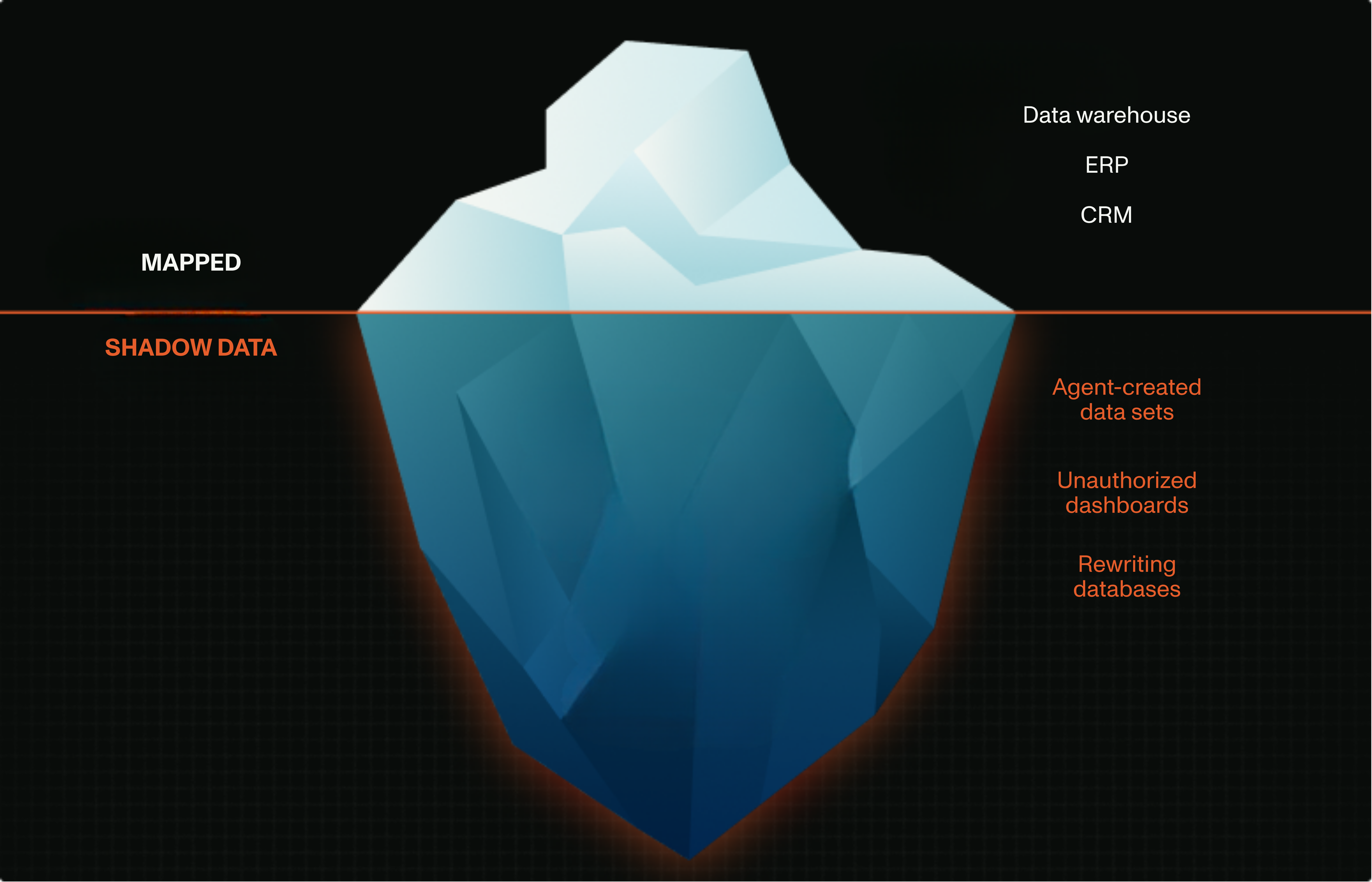
- AI agents are creating a new kind of shadow IT by generating and storing data outside established governance.
- This creates fragmented, competing versions of enterprise data that can undermine trust in AI and business decisions.
- Traditional governance struggles because agents can access, transform, and write data without clear ownership or lineage.
- An AI-ready data foundation gives agents and teams a shared, trusted view of data, its meaning, relationships, and lineage.
- Leaders can start by mapping AI-generated data, controlling write access, tracking lineage, and assigning ownership.
Picture this:
Your Sales Ops Planning team wants to reduce stockouts without increasing inventory. To speed up the process, a data engineer built an agent that pulls inventory data from ERP, WMS, supplier portals, and warehouse records. This agent reconciles these sources and creates a dataset that shows available inventory, committed stock, incoming shipments, etc.
Because this agent pulled data from “trusted, vetted AI-data sources,” no one questioned it. Even the procurement agent used this dataset and decided it was okay to delay an order.
However, after the first agent went live, several warehouses spotted hundreds of damaged items. Both the WMS and ERP were updated. But none of those updates showed up in the dataset the first agent had already created.
Because other agents are already making decisions based on the original agent's dataset, the enterprise is now using two different versions of inventory data reality.
As enterprises deploy more agents, this problem will only become harder to contain. We at Turgon believe the right balance between agency and control creates maximum impact. But without sufficient control, adding more agents creates a new shadow IT problem.
How AI Agents Lead to Shadow Data
Ungoverned AI agents ingest already siloed and incomplete enterprise data and then create new layers of derived, incorrect data. This cycle continues, and the shadow data problem becomes real.
Back in 2023-2024, the first wave of AI flooded workplaces. Everybody wanted their workforce to use chatbots and get things done faster. But later, cracks showed up:
- Sensitive data got leaked into third-party AI systems
- Unsanctioned AI tools created regulatory violations
- Self-directed AI tools generated output that led to lawsuits for defamation and economic damages
The nature of the violation mainly stayed within privacy, risk, and compliance. AI agents, however, multiply that complexity by adding both IT security and operational challenges.
AI agents can pull data from CRMs, create new data sets, feed data to other agents, and overwrite information in operational systems and databases. This creates the data fragmentation problem due to agent sprawl. Each independent AI Agent can have its own pipeline, retrieval layers, caches, and interpretation of enterprise data. With time, these isolated AI agent-based systems become mutually disconnected pockets of enterprise knowledge. Once established, even when new changes appear in source databases, these pockets can’t reflect those changes.
The current AI agent boom further complicates the situation. With tools like Claude Code, Codex, Lovable, and others, anybody can create an operational AI agent and add to your shadow IT load. Also, governance isn’t keeping pace with adoption. Gartner found that only 13% of organizations have proper AI agent governance.
Unchecked AI agents are creating a massive risk of a new type of Shadow IT that affects both security and operations.
What This Data Fragmentation Actually Costs the Business
When agent sprawl duplicates and fragments the enterprise data layer, problems show up in areas data leaders care most: trust, scalability, and regulation.
Less confidence in AI outputs
Enterprise AI agents are notorious for acing in demos and failing in production. One of the biggest points of failure is the quality and consistency of the data they operate on. (No wonder organizations with successful AI initiatives spend 2-4X on D&A foundations.)
Most enterprises already have a heterogeneous data landscape, spread across CRMs, ERPs, data warehouses, operational systems, and legacy applications. When AI agents add more derived data and fragmented contexts, they eventually start operating on competing versions of data reality. It can negatively affect accuracy and predictability.
Once an output has been wrong without a clear explanation, the practical response isn't debugging; it's distrust. Teams start double-checking the agent's numbers by hand, which erases the time savings the agent was built to deliver in the first place.
Data governance becomes reactive
Traditional data governance focuses on defining the data, how it is stored, who uses it, and how. It assumes data is for human consumption through applications, BI tools, and APIs. Governance tools mostly control those pathways. AI agents break that core assumption by not consuming data. They directly access databases, interact with them, and sometimes rewrite the data.
When data layers get fragmented by agents deployed behind the IT department (a classic “shadow AI” pattern), it further pressures existing data governance. Each ungoverned agent creates its own data definition, and unclear ownership means no clear escalation paths. Eventually, data governance falls behind, and risks go up.
Scalability becomes an issue
Eight out of ten companies cite data limitations as a main cause of agent scalability failure. With a fragmented data foundation, scalability becomes a nightmare.
Experts like Emil Efrem explained this problem: Before deployment, every agent has to rediscover where data lives. Then teams have to determine which of the multiple duplicated data sources can be trusted. Even after deployment, if something changes, every agent has to be rewired manually.
This reality makes scaling agentic activities slow, difficult, and low-ROI. Every new agent an enterprise wants to deploy inherits the same rediscovery and rewiring tax as the last one. So companies that skip the data foundation don't just get one slow agent; they get every future AI initiative building against the same unsolved problem. That’s exactly how a pilot that worked in one team never makes it to the other nine.
Fragmentation makes compliance harder to prove
A big part of AI governance is being able to show the paper trail that proves compliance. An unmanaged agent does not automatically violate regulations such as the EU AI Act. But if an organization cannot explain where its AI data came from, how it was transformed, what it represents, and which version informed an output, demonstrating that the system meets those requirements becomes much harder.
The burden of proof sits with the enterprise, not the regulator. When an audit or incident review asks 'show us,' 'we believe our data was probably fine' is not an answer that holds up, and the fallback is an expensive forensic reconstruction under time pressure, often for a system that's already in production and hard to pause. For high-risk AI systems under the Act, it's the difference between a documented control and a fine.
What a Healthy AI-Ready Data Foundation Looks Like
A healthy data foundation must have every table, metric, and field documented, lineage established, and entity identity resolved. It can change what an enterprise trusts and how fast it moves. It can mitigate the agentic shadow AI challenge to a great extent.
Here is how success appears in practice:
Documented fields and tables
An enterprise often has thousands of tables scattered across the organization without proper schema documentation. It makes finding sources harder.
A fixed ontology documents and then assigns meaning to each table. It creates a semantic layer that provides shared context.
Explicit relationship
In enterprises, a handful of employees and teams hold the “tribal knowledge” and know the exact data relationships between multiple systems. They know where the data comes from, which field determines the price, and how field dependencies work.
In an AI-ready data foundation, those relationships are properly discovered and documented. Turgon agents can reveal those relations by analyzing internal documents, meeting recordings, Teams chats, and more, to create a comprehensive Business Requirements Document automatically.
Traceable lineage
An enterprise must have visibility into how source data transforms into derived data and finally into agent output. For both governance and scalability, this info is critical.
A unified data ontology maps out the lineage of enterprise data. Observers can trace the path: source → transformation → derived data → agent → output. That chain includes the intermediate artifacts that influence AI decisions, like extracted content, chunks, embeddings, and retrieved context.
Accessible to non-technical teams
Non-technical teams contribute to the agentic shadow IT problem because the barrier to unified data access is high.
A unified data ontology, by design, makes the info available seamlessly. It offers AI assistant features that let any authorized user ask questions in plain language and receive answers without getting into technicalities.
The Turgon team usually introduces a co-pilot once the enterprise data layer is fixed. Through it, non-technical teams gain access to unified data instantly without needing to contact the IT department every time.
Zero rediscovery
With an unresolved data foundation underneath, every agent deployment starts by re-investigating the same tables and relationships.
A fixed ontology lets users bypass that rework by presenting a shared data map. It also outlives the people who built it. When an employee leaves, the remaining team can quickly comprehend the enterprise data map and relationships.
Impact of an AI-Ready Data Ontology: McCarthy Tire Case Study
McCarthy Tire Services, one of Turgon’s clients, is a great example of how a fixed enterprise ontology (using an agentic approach) can deliver real-world impact.
For context, McCarthy Tire Services is a 100-year-old tire retailer with 100+ locations. It runs critical operations on a 30-year-old IBM i AS/400 midrange system. Before the unified data foundation, McCarthy Systems had over 40000+ tables that were not mapped, defined, or visible. Such a massive scale of fragmented data had slowed down critical decision-making.
Here is how Turgon’s enterprise data modernization approach knocked down McCarthy’s data challenges:
- Turgon’s data agent built a complete semantic model of the existing IBM i system in 4 days. It analyzed structures and relationships across 40000+ tables and surfaced hard-to-spot implicit relationships.
- Turgon’s data engineers collaborated with McCarthy internal teams to validate the semantic model against established business processes.
- Once the data map was ready, Turgon’s specialized agent coded and built the entire pipeline to Snowflake.
- Turgon team introduced a data discovery chat that allows users to ask questions about table relationships and data lineage in plain language without needing to understand schemas.
- Multiple dashboards were built to provide McCarthy leadership with clear visibility into purchasing patterns, sales performance, and inventory data.
Here was the impact:
- McCarthy’s pressing data challenges were solved within 5 weeks. That timeline was almost one-third of what traditional data system integrators had quoted.
- The data foundation took four days to establish. Now the McCarthy team can introduce any analytics or Agentic projects without firefighting data chaos every time.
- The whole transition took place with zero operational interruption.
- Traditional system integrators estimated $500k to $1M for a project this big. However, an agentic+human approach reduced the cost by 70%.
The takeaway is that there are traditional ways to unify the data layer and migrate. However, those processes often require senior engineers to take care of both strategic oversight and manual work. It increases both time and budget commitment.
Turgon uses agents to free engineers to focus on problem-solving, strategic judgment, and oversight. It makes the data-layer unification faster yet governed.
You can check out more details on the McCarthy Tire Services case study on Turgon’s website.
A Practical Checklist for Data Leaders to Act on This Quarter
Restructuring an entire enterprise data layer is a big initiative that requires significant budget, planning, and top leadership approval. However, you can take some steps this quarter that would take the whole organization one step closer to managing agentic shadow IT.
Here is the checklist the Turgon team recommends:
1. Find the shadow data:
Start by mapping the copilots, agents, and automated workflows already touching enterprise data. Find which new tables, exports, views, embeddings, and ad-hoc datasets agents are creating. Anything sitting in a personal schema, local file, or ungoverned database deserves a closer look.
2. Establish a data creation policy:
Define where AI-generated data is allowed to be stored within the company’s data environment. Also make it mandatory to register all AI-created tables in a catalog. Every persistent asset should follow a naming convention, have an owner, and a purpose.
3. Lock down write access
Check which copilots and agents can create or modify data in production. Give AI tools the access they need to read enterprise data, but keep write permissions narrow and intentional. Route AI-generated outputs through a staging or sandbox environment first, so someone can review and validate them before they become part of the production data foundation.
4. Add lineage and tagging
Any AI-generated asset should have mandatory tags: source tool, data, creator, purpose, and inquiry. These tags will help with establishing lineage later.
Implement a data lineage tracking system, and if you have an existing system, integrate your AI agent outputs there.
5. Set Expiry & Cleanup Rules
Don't let temporary data become permanent infrastructure. Most experimental AI-generated datasets should have a short life, usually 30 to 90 days unless someone with authority promotes them. Run a monthly purge of any dataset without clear ownership.
6. Monitor & Measure
Track the volume of new data assets AI tools create and their origin. You should have an alert system that flags whenever dataset creation deviates from the norm (for example, a sudden influx of tables by one team should be a red flag).
Also report these metrics to leadership quarterly. When it becomes visible to the leaders, managing agentic shadow IT becomes easier.
7. Give teams ownership
Ensure analysts and engineers are aware of the AI agent policies before they deploy new AI agents. Also, you can turn AI governance from a central responsibility to a shared one with two decisions:
- Introduce a 15-minute AI-hygiene module to onboarding.
- Assign a data steward per team to watch over departmental AI-generated output and report back.
AI agents will create data to get the job done. However, when you govern, empower, and define, data silos created by AI agents can be contained and managed. You also stay compliant with regulations and avoid major incidents.
However, governing AI agent outputs is only one part of shadow IT management. To scale your productive agentic activity, you need to build a unified AI-ready data ontology. Turgon fuses agentic enterprise data modernization with human judgment, which makes the transition faster, affordable, and robust. Book a demo to understand its impact.
FAQs
1. What is the difference between shadow AI and shadow data?
Shadow AI is the use of AI tools or agents without the organization’s knowledge or approval. Shadow data is what those tools create or alter: new datasets, derived outputs, embeddings, caches, or copies that sit outside the governed data environment.
2. How do AI agents create data silos without anyone noticing?
Agents can pull information from multiple systems, transform it, and create their own datasets, retrieval layers, caches, or interpretations. Over time, each agent can end up operating from its own version of enterprise data, even when the underlying source systems have changed.
3. What does AI-ready data actually mean?
AI-ready data is more than clean or accessible data. It needs clear definitions, documented relationships, traceable lineage, and enough context for an AI system to understand what the data represents and where it came from. It’s creating a shared map of enterprise data and its relationships.
4. Can existing data governance tools handle data created by AI?
They can help, but they weren't necessarily designed for the scale and speed at which agents can create and transform data. The important shift is extending governance to AI-generated assets—who created them, what they contain, where they came from, how they changed, and whether they should remain in the environment.
5. How long does it take to build a unified data foundation?
There isn't a universal timeline because it depends on the size, complexity, and condition of the existing data environment. But it doesn't always require a multi-year transformation: in the McCarthy Tire Services example, Turgon established the initial data foundation in four days and completed the broader project in five weeks.
6. Is this a security problem or a data architecture problem?
It's both, but the deeper problem is architectural. Security controls can restrict what agents access or write, but they don't solve conflicting definitions, duplicated data, missing lineage, or fragmented knowledge. You need both access controls and a data foundation that gives agents a consistent, governed view of the enterprise.