
TL;DR
- Traditional data modernization is expensive because of semantic debt, hidden dependencies, rewrites, parallel systems, and stakeholder alignment.
- AI can reduce modernization costs by automating discovery, mapping, transformation, testing, and validation.
- AI-driven parallel execution reduces repetitive engineering work and the human hours required for large-scale migrations.
- Uncontrolled AI introduces new costs through incorrect mappings, missing business logic, and excessive system permissions.
- A governed human-in-the-loop approach keeps AI agents within defined scopes while escalating uncertain decisions to experts.
- Modernization economics improve when enterprises remove unnecessary workloads, align processing with business needs, and eliminate legacy baggage.
- The new model shifts experts from manual grunt work toward agent governance, architectural decisions, and strategic oversight.
An enterprise spent years gradually building its data environment by patching together ERPs, CRMs, warehouse systems, databases, and applications from various vendors.
It worked for some time. However, as the organization added new data sources and technologies, cracks started to appear:
Simple ETL jobs took hours to run. Some of the components reached the end of their life cycles. New vendor updates created security issues. Pipelines failed to keep up, and teams had to manually move information between systems. Most importantly, as the system maxed out, data silos formed across the organization.
In our experience, this is a common situation for enterprises that depend on legacy systems with modern tech patched on top. It hinders decision-making, creates security vulnerabilities, and limits agentic capabilities.
Enterprise leaders are responding to that by prioritizing data modernization. According to Deloitte's 2026 report, 78% of CDAOs have confirmed that their organizations are actively implementing it.
Many enterprises bring in system integrators (SIs) for such critical undertakings. However, these engagements often last months, and data modernization costs can reach 6- to 7-figures, according to one modernization firm's analysis of 47 projects.
Why Data Modernization Costs Have Traditionally Been High
The massive cost of legacy system modernization comes from underlying data issues, hidden dependencies, parallel run costs, and stakeholder alignment.
In our experience, the following factors contribute the most:
Semantic Debt
Most legacy systems accumulate what we call “semantic debt”. It’s basically all missing data, hidden contexts that live in a handful of individuals' minds, and inconsistent data semantics. This debt can easily travel downstream. When it does, and if lineages aren't clear (which is common), rework can increase overall project costs.
Stored Procedures and ETL Rewrites
Legacy systems often have important business logic buried inside old ETL pipelines, stored procedures, and custom code. You often find hidden rules and dependencies buried deep in documents, emails, and CRMs. Finding and rebuilding them correctly can take more time than expected.
Stakeholder Alignment
Data modernization is not an engineering-only initiative. It includes all the teams that access, use, and make decisions based on the data. Coordinating across teams, discovering tribal knowledge, and securing approvals can extend the project timeline and cost.
Parallel Run Costs
Enterprises must keep their existing system running while the new data system is being built. Running two systems in parallel also increases the overall project cost.
Monitoring and Observability Cost
Newly established data pipelines need ongoing monitoring for failure, freshness, and lineage. Monitoring tools and observability platforms add overhead that often doesn’t show up in the projected cost.
Discovery Workshops and Knowledge Extraction
System integrators (SIs) spend weeks conducting discovery workshops and stakeholder interviews to extract undocumented business rules, workflows, and dependencies from employees. These sessions can consume hundreds of employee-hours and disrupt various teams’ day-to-day responsibilities. Though it often goes unreported explicitly, the cost of lost employee productivity and delays to ongoing work can be substantial.
How AI Changes the Economics of Data Modernization
Dedicated AI agents can massively reduce data modernization costs. For instance, in one engagement, we cut costs by 70%. We achieved it by reducing the manual work required to understand, transform, and validate complex environments.
In our experience, the biggest impacts of AI show up in the following areas of the modernization process:
- Faster discovery: AI can analyze large codebases, schemas, configurations, and dependencies to help teams understand an environment faster than manual discovery alone.
- Automated mapping and transformation: AI can identify relationships between legacy and target schemas and generate much of the code needed to transform workloads.
- Parallel execution: AI agents can handle multiple modernization tasks simultaneously. It basically saves many human billable hours otherwise spent on engineers working through thousands of tables, jobs, and dependencies sequentially.
- Less repetitive engineering: AI agents free engineers to spend less time writing boilerplate transformation code and more time reviewing exceptions and interviewing stakeholders. As a result, better architectural decisions are made based on valid business-critical logic.
- Shorter cycles: When discovery, transformation, testing, and validation become partially automated, it makes the modernization project shorter (and eliminates the need to keep parallel systems alive).
There is a caveat, though: AI agents can hallucinate and confidently push those downstream without raising any alarm. We, at Turgon, strongly believe in a hybrid human+governed agentic approach, because uncontrolled AI can introduce a different set of costs:
- Wrong schemas and mappings: AI can confidently infer relationships that look reasonable but are incorrect, particularly when documentation is incomplete. To address this, we, at Turgon, use multiple verification signals rather than relying on a single agent's confidence:
- Independent verification: A second agent checks the data agent's findings against the available evidence. It actively looks for errors rather than simply confirming the answer. If the agreement score is 0.9 or higher, the data agent’s work is auto-accepted. A 0.7–0.9 score calls for a human review, and anything less than 0.7 requires escalation.
- Self-consistency: While mapping data, the Turgon data agent repeats the task across multiple independent runs to check whether it consistently identifies the same schemas and relationships. Consistent results increase confidence, and conflicting answers trigger further review.
- Grounding: We check whether the agent's conclusions are supported by source data and retrieved records rather than merely sounding plausible.
- Rule validation: Deterministic checks validate schemas, data types, value ranges, referential integrity, and business rules.
- Missing business logic: Some of the most important rules may exist only in people's heads or in undocumented processes. AI, on its own, can't reliably find rules that were never documented.
- Over-permissioned agents: AI agents can introduce security and governance risks if they have unrestricted access to production systems or sensitive data. For example, an agent with access to sensitive PII records can map a sensitive field to a less-restricted destination where anyone can see it.
At Turgon, we solve this through agent-human collaboration. First, agents work in isolated development and staging environments, where they analyze source metadata and masked data samples to generate migration scripts, transformation logic, data layers, validation rules, and pipelines. Our Forward Deployed Engineers (FDEs) review and approve these artifacts at human-in-the-loop checkpoints. Only after human QA and customer user acceptance testing (UAT) can we promote changes to production. This ensures agents never autonomously push changes to live customer systems.
How AI Is Reducing the Total Data Modernization Cost for a Global Enterprise: A Turgon Client Case Study
The work we did for a client is a strong example of how proper AI use can reduce data modernization costs.
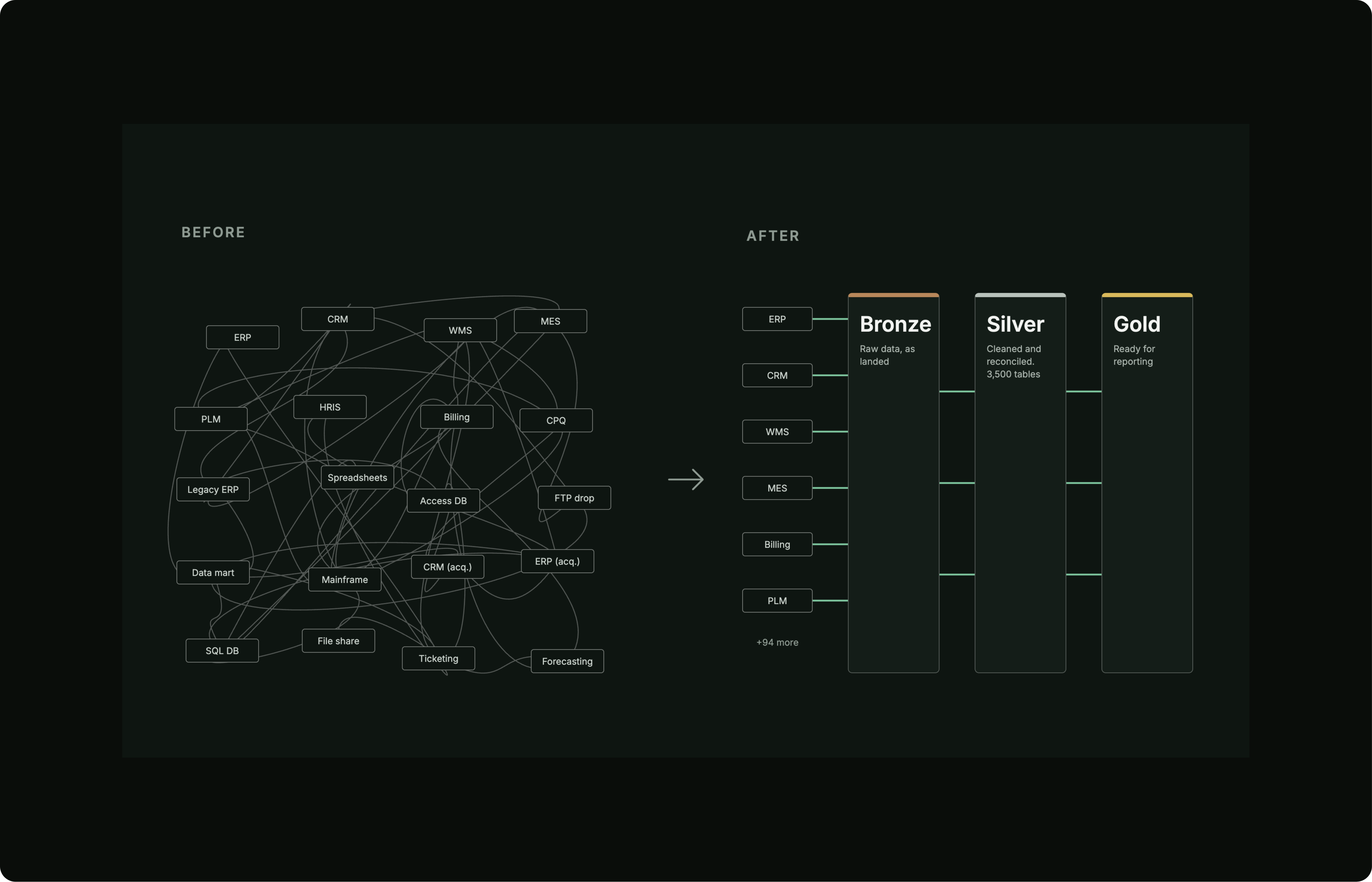
Our client, a multibillion-dollar enterprise data infrastructure technology manufacturer, had grown largely through acquisitions. Each acquisition added its own legacy platforms, data sources, and CRM tools to our client’s data ecosystem. When they reached out, they had 100+ disconnected systems with no single view.
They estimated roughly 6,000 tables were scattered across these systems. Hundreds of millions of dollars in inventory and receivables were effectively invisible because teams had to know where to look before they could find them.
Traditional system integrators estimated that modernizing the environment would take 1.5–2 years.
Turgon's hybrid agentic approach helped our client get out of that chaos differently:
- AI accelerated discovery: In the first phase, Turgon agents mapped the data landscape across 12 business-critical systems and discovered that nearly 2,500 of the estimated 6,000 tables were empty.
- AI accelerated migration: We moved 3500 tables from source to silver, built a governed medallion lakehouse on AWS, and built config-driven CDC pipelines with full history tracking within 3 months. The core ERP's source-to-silver transformation ran in roughly two days.
- AI handled scale: One particular source system contained a table with more than one billion rows. Turgon agents engineered an eight-way parallel load strategy to migrate it without extending the project timeline.
- Human oversight remained in the loop: We reviewed every table against Turgon’s standard data-quality dimensions. While reconciling financial tables, for example, 9 tables required additional judgment, and agents routed them to the customer's team for approval. The remaining 372 tables were accepted without human review.
- Lineage remained intact: No source-system columns were dropped, and every row retained information about where it came from and what changed.
- AI shortened the reporting cycle: To validate the new foundation, we rebuilt a revenue analytics report in 5 business days compared with the client's typical one-month reporting cycle.
- Governance stayed visible: A live migration command center with approval workflows and daily status updates gave leadership visibility into the modernization process.
This engagement is ongoing. Our hybrid AI approach helped reduce the overall cost of modernization. We shortened the timeline, caught hidden dependencies and data relationships early, avoided rework, and reduced the time the client needed to keep their old systems running.
The takeaway is that, with governed agentic capabilities and skilled human expertise, you can drastically reduce direct and indirect enterprise data modernization costs. In this situation, how you do it matters as much as what you do.
The New Data Modernization Playbook
AI-assisted data modernization can take different paths depending on use cases, data environments, and organizational contexts. But if you strip away those differences, here is what the core of a data modernization strategy looks like:
1. Map the Entire Data Environment
Start by building a clear picture of systems, pipelines, workloads, dependencies, and where data actually flows. You need this ontology map to know what you’re working with and where problems can arise.
2. Tie Infrastructure Costs to Business Workloads
Map each cost to the reports, applications, analytics, or business processes it supports so you know where reductions will actually make a difference.
3. Identify Unnecessary Workloads
Modernization often uncovers workloads that have simply been carried forward over the years. Look for unused queries, jobs, dashboards, ETL processes, and data movement that no longer support a meaningful business need.
4. Align Processing Frequency With Business Need
Understand how quickly each business process actually needs fresh data, then set refresh and processing schedules accordingly.
5. Remove Legacy Migration Baggage
A modernization project can reproduce the old environment in a newer stack if left ungoverned. Therefore, you want to review inherited integrations, connectors, and processes and remove those without a clear purpose. In our client’s case, we found 2500 empty tables that they had carried for years.
6. Make Changes Without Disrupting Production
Cost optimization shouldn't require pausing critical operations. Make changes incrementally while keeping essential pipelines and downstream systems running.
7. Human-in-the-Loop Should Function as a Control Plane
It’s not enough to have overworked experts who can sign off on agents’ outputs. The system’s review load (work rate × escalation rate × avg handling time) has to stay below what your experts can realistically review.
Also, human judgments must be fed back into agents' memory as context so the same question isn't escalated twice.
8. Build Governance and Visibility Into the New Environment
Make it easy to see what is running, why it exists, who uses it, and what it costs. This visibility helps stakeholders spot waste early and keep data modernization costs under control.
What Data Modernization Economics Look Like Now
A big part of any legacy data modernization undertaking is reducing uncertainty.
Some of the most critical tasks are to reveal where the actual data lives, how systems depend on each other, which business logic influences data reality, and what downstream impact looks like.
Much of that investigation is repetitive and slow.
In a traditional approach, human experts are closely involved in mapping data reality, digging through CRMs and communication channels, and managing stakeholders.
AI turns the tables by making enterprise complexity far cheaper to understand at scale.
But that doesn't mean handing every decision over to agents is a good idea. Instead, the right approach would be: humans lead the way, and AI takes care of the grunt work.
In practice, that means experts stop being final approvers and focus on defining agent scopes, eliminating data ambiguity, making architectural decisions, ensuring resource allocation, and feeding those decisions back to the agentic layer.
You're reducing the cost of understanding, deciding, and continuously improving your data environment.
That's the idea behind our agentic AI for enterprise data modernization at Turgon, and we're constantly honing this model for better accuracy and scale while maintaining oversight.
Ready to rethink the economics of your data modernization? See how we modernized McCarthy Tire Service's legacy infrastructure in 5 weeks, or feel free to book a demo.
FAQ
What factors drive the cost of data modernization?
For an enterprise, data modernization costs can range from a few hundred thousand to multi-million dollars. Semantic debt, hidden business logic, stakeholder alignment, and monitoring: all of these factors can influence it. Unclear data lineage and dependencies can create rework, and keeping legacy systems operational during migration adds further indirect costs.
How much can AI reduce data modernization costs?
It really depends on the organization’s data situation, context, and use cases. However, in one engagement, we delivered data modernization at 70% less cost than what SIs quoted, without compromising quality or results. The savings came from governed agents handling discovery, mapping, and running tasks in parallel. Our human engineers were fully focused on strategic decisions, reconciling semantics and overseeing agentic outputs.
How do we decide which legacy systems and workloads to modernize first?
Start by mapping the entire data environment. Understand which systems, workloads, and dependencies support critical business processes. Then identify unnecessary workloads, unused queries, jobs, dashboards, and data movement. Tie infrastructure costs back to business workloads so you can prioritize modernization where it can deliver significant operational or financial impact.
What risks should CDOs consider when using AI for data modernization?
AI can confidently make incorrect assumptions when documentation is incomplete. Undocumented business knowledge may be impossible for an agent to infer. Broad access to production systems can also create governance and security risks. Human review and clearly defined agent scopes help manage these risks.