
Commercial real estate operator unifies leasing data visibility in weeks

A major Middle East real estate operator’s leasing data was spread across multiple disconnected systems, making reporting slow and compliance and revenue risk hard to manage. Turgon built a governed data lakehouse and multi-agent orchestration on top of the gold layer spanning Yardi, the Ejar registry, and their workflow system. The team now gets real-time, provenance-backed answers to any leasing question in English or Arabic, with data quality issues flagged, ranked, and routed automatically for resolution.
17
weeks to production
6+
systems unified
17
auto-enforced policies
The Customer
A leading commercial real estate operator in the Middle East managing large-scale retail, entertainment, and mixed-use destinations runs Yardi Voyager as its system of record for leasing and revenue. Every lease carries a contract registered with Ejar, the Saudi government's national leasing platform, and lease approvals run through a separate workflow system. With thousands of leases, the addition of new developments, and information across multiple systems, they faced a growing revenue and compliance risk.
The Problem
The operator's leasing, tenant, and financial data lived across separate systems that never checked against each other: lease terms and charges in Yardi, Ejar carried the regulatory registration in Arabic and English, and the workflow system ran approvals. The same lease could look different based on the system.
Compiling a monthly report took days and required manually pulling data from spreadsheets and several systems into Excel. Without a single definition across systems, meeting time was lost discussing which occupancy number was right, and challenged figures rebuilt from source.
Without these systems being cross-checked, data quality issues were found reactively. Registry mismatches, duplicate or contradictory lease records, unactioned expiries, and concentration building in single customer groups went unnoticed for months at a time, surfacing only at audit, at a credit event, or at year end.
The Solution
Turgon built the platform on a governed medallion lakehouse, with Bronze, Silver, and Gold layers running on Databricks in the operator's own cloud tenancy, without touching any underlying application or schema. Source systems land in Bronze exactly as they arrive. Silver resolves records into conformed entities, deduplicated and normalized across English and Arabic, with data quality gates applied before promotion. Gold carries the leasing measures the business argues about, defined once and computed once, so every agent, dashboard, and report reads from the same numbers. Every change to a lease's term, rate, or area is stored as a dated amendment rather than an overwrite, so the position on any past date can be reconstructed straight from the record.
The Multi-Agent Layer for Leasing Data
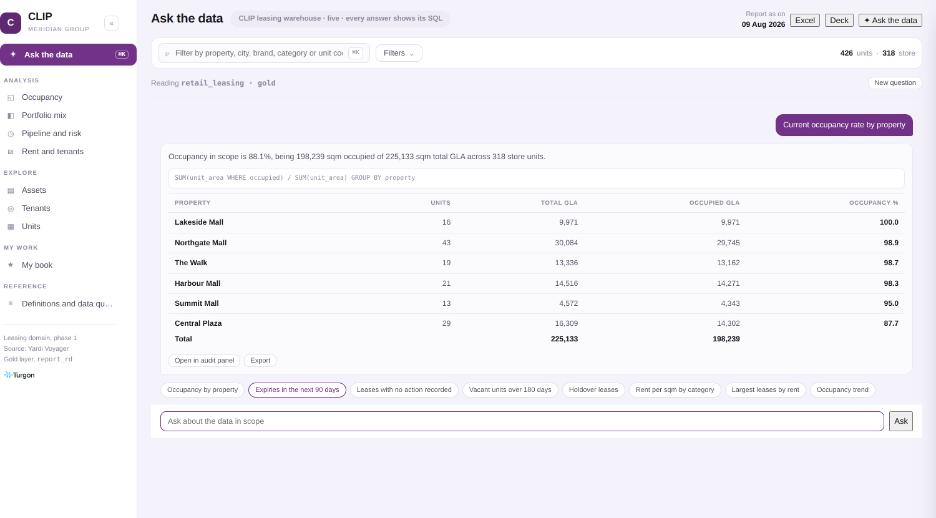
To help the team access fast accurate answers about its leasing data, Turgon built a multi-agent orchestration layer on the MCP on top of Gold. A controller agent breaks down each question and dispatches nine specialist agents in parallel across leasing, receivables, collections, budgets, workflow, data quality, and the Ejar registry. The team can ask questions in English or Arabic and get back a result with its full provenance: which sources were queried, which tables and live APIs were used, and the logic that merged them. Sessions hold memory, so follow-up questions stay in the same conversation, and any result exports to Excel, PDF, or PowerPoint in one click.
The Compliance and Data Quality Engine
Turgon implemented 17 automated data quality rules across Yardi and 5 other systems that catch costly failures: two active leases on the same unit, a move-out date in the past, a rent schedule diverging from the contractual rent, or a proposal approved in one system but pending in another. For Ejar compliance, contract PDFs are extracted with OCR in Arabic and English, including Gregorian and Hijri dates, and every lease is cross-validated field by field against its registry contract. Any discrepancies land in an exception workbench, ranked by severity with a recommended fix, and alerts notify people in-app, in Microsoft Teams, and by email within moments of a breach.
Consistent Dashboards on the Same Gold Layer
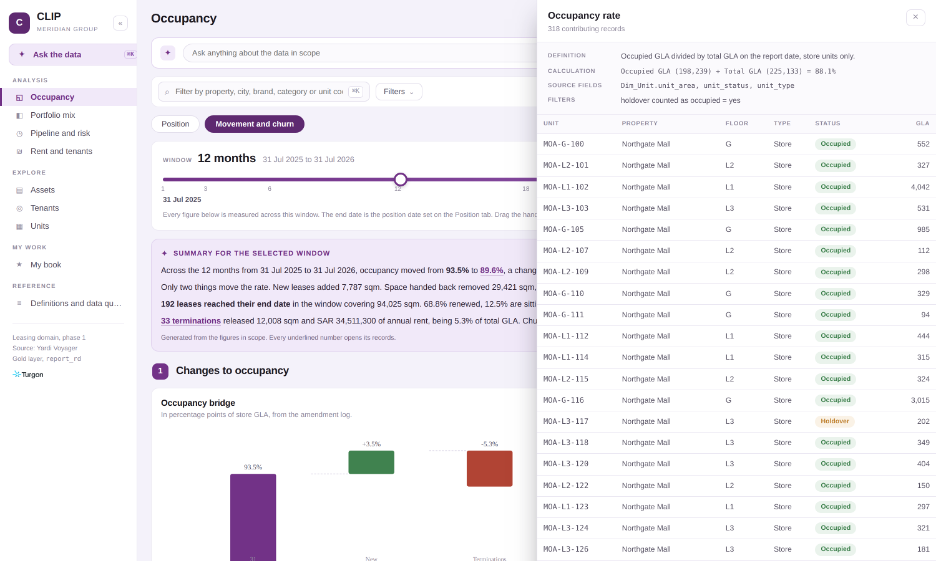
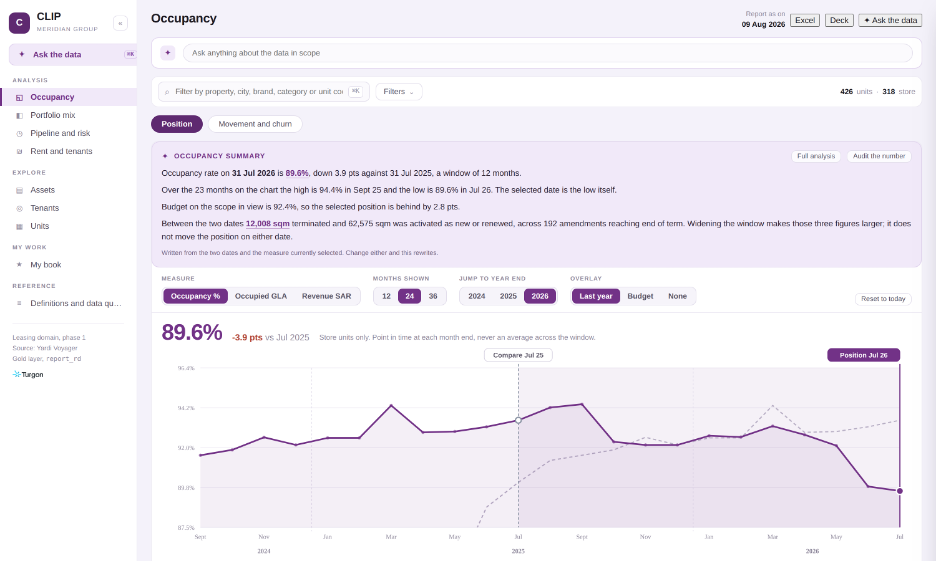
The same agents responding to a chat and the platform's dashboards read from that one gold definition set. On the occupancy dashboard, the chart filters the data on the screen from a consistent accurate data layer. Portfolio mix, pipeline and risk, rent benchmarking, and asset and counterparty views all read from that same layer.
The conversational surface and the platform screens read from one definition set, so a figure quoted in a chat answer and the same figure on a dashboard cannot disagree. Occupancy is built around choosing dates rather than reading them: the chart is the filter, and every figure on the page follows the selection. Portfolio mix, pipeline and risk, rent benchmarking, asset and counterparty views all read from the same golden layer.
The Results
Real-time Answers Replace the Reporting Cycle
- Questions that used to take days now take seconds, and each answer arrives with its evidence attached. Follow-up questions get answered in the same session instead of re-entering a reporting queue, freeing analyst time once spent assembling the pack to be spent interrogating it.
One Governed Source of Truth
- Every measure has one definition, applied to all dashboards and reports, and any questionable figure open straight into the records that produced it. A leasing director can trace any challenged number to its underlying leases in the same meeting.
Compliance and Data Quality Enforced
- 17 always-on rules and field-level Ejar cross-validation catch registry mismatches, duplicate leases, and rent discrepancies as they occur, and quantified and routed for resolution. Every flagged gap carries the value at stake, so the team works the highest-value exceptions first.
Faster Time-to-Value to a Full Platform
- A scoped proof of concept on a single mall was delivered in weeks, and the full platform was structured as a 17-week phased program. The same lakehouse, agent framework, and governance pattern now extend to finance, marketing, and facilities as each new domain lands, with leasing as the first.